
Since the 1860s, the automotive industry has been driven by innovation and technological advancements, with manufacturing progress standing as a core pillar of its evolution. Among the transformative technologies shaping automotive production, CNC (Computer Numerical Control) machining has emerged as an indispensable force, revolutionizing how auto parts are designed, prototyped, and mass-produced. This article delves into the multifaceted role of CNC machining in auto part manufacturing, covering its advantages, applications, materials, equipment, comparisons with alternative technologies, limitations, future trends, and the comprehensive services offered by industry leaders like HLW.

Core Advantages of CNC Machining for Auto Parts
CNC machining has gained widespread adoption in the automotive sector due to its unparalleled combination of performance and flexibility, addressing the industry’s relentless pursuit of precision, efficiency, and reliability.
Precision and Repeatability
Precision is non-negotiable in automotive manufacturing, where even minor deviations can compromise vehicle performance, safety, and reliability. CNC machining delivers exceptional accuracy, achieving tight tolerances as low as +/-0.01 mm, which is critical for functional components like engine parts, transmission gears, and brake systems. As a computer-controlled process, it ensures consistent repeatability across batches, guaranteeing that every part adheres to the same strict standards—an essential requirement for maintaining uniformity in mass-produced vehicles.
Enhanced Efficiency and Automation
Automation is a defining strength of CNC machining, enabling continuous, uninterrupted production runs with minimal human intervention. Robotic arms assist in part loading and unloading, freeing workers to focus on design, innovation, and quality control. Compared to traditional manual machining, CNC systems significantly reduce cycle times, even for medium-to-high production volumes, and allow rapid changeovers between different part designs through reprogramming—eliminating the need for time-consuming retooling. This efficiency translates to shorter lead times, with providers like HLW capable of delivering automotive components in as little as three days.
Versatility in Complex Part Manufacturing
Automotive parts often feature intricate geometries, curves, and contours that are challenging or impossible to produce with traditional methods. CNC machining, particularly multi-axis (3-axis, 4-axis, 5-axis, and even 9-axis) systems, enables cutting tools to move in multiple directions, carving out complex structures such as engine blocks, cylinder heads, hypoid gears, and suspension components in a single operation. This versatility extends to both prototyping and full-scale production, supporting the development of sophisticated, high-performance auto parts.
Design Flexibility and Customization
The automotive market’s dynamic nature demands rapid design iterations and customization capabilities. CNC machining integrates seamlessly with Computer-Aided Design (CAD) software, allowing engineers to modify part geometries easily and translate designs directly into machine instructions. This flexibility supports low-volume production, one-off custom parts, and vintage car restorations—where reverse engineering and CNC machining combine to recreate obsolete components. While additive manufacturing offers strong customization, CNC machining excels in producing durable, customized parts with short lead times for both prototypes and end-use applications.

Cost-Effectiveness in the Long Run
Although industrial CNC machines require significant upfront investment, they yield substantial cost savings over time. By optimizing material usage, minimizing waste (swarf), and eliminating the need for dedicated jigs or fixtures for each part, CNC machining reduces overall production costs. Additionally, the high precision and reliability of CNC-machined parts lower defect rates and maintenance costs, enhancing the long-term profitability of automotive manufacturing operations.
Key Applications of CNC Machining in Auto Part Production
CNC machining’s versatility enables it to produce a wide range of automotive components, spanning from prototypes to critical end-use parts across all vehicle systems.
Prototyping
Rapid prototyping is a vital stage in automotive development, allowing engineers to test design feasibility, fit, and functionality before full-scale production. CNC machining excels in creating high-quality, functional prototypes that closely resemble final parts. Common prototype applications include lighting components (using clear acrylic materials), engine parts, dashboard components, and suspension systems. For electric vehicles (EVs), CNC machining also plays a crucial role in finishing 3D-printed prototypes to meet strict tolerance requirements.
Engine Components
Engine systems demand the highest precision and durability, and CNC machining is the preferred method for manufacturing key components such as cylinder heads, engine blocks, crankshafts, camshafts, pistons, valves, and connecting rods. These parts are often machined from aluminum (for heat dissipation), steel, or titanium, with multi-axis systems ensuring intricate details and optimal performance. HLW’s advanced machining capabilities, including 5-axis and 9-axis systems, enable the production of complex engine parts for both internal combustion engine (ICE) vehicles and EVs.
Transmission and Drivetrain Components
Transmission systems rely on CNC-machined parts for efficient power transfer and smooth operation. Key components include gears, gearboxes, shafts, bearings, clutches, drive axles, and universal joints. CNC machining ensures tight tolerances for these parts, guaranteeing seamless shifting, reduced wear, and reliable performance. For custom or high-performance vehicles, CNC machining supports the production of specialized transmission components tailored to specific power requirements.
Suspension, Steering, and Brake Systems
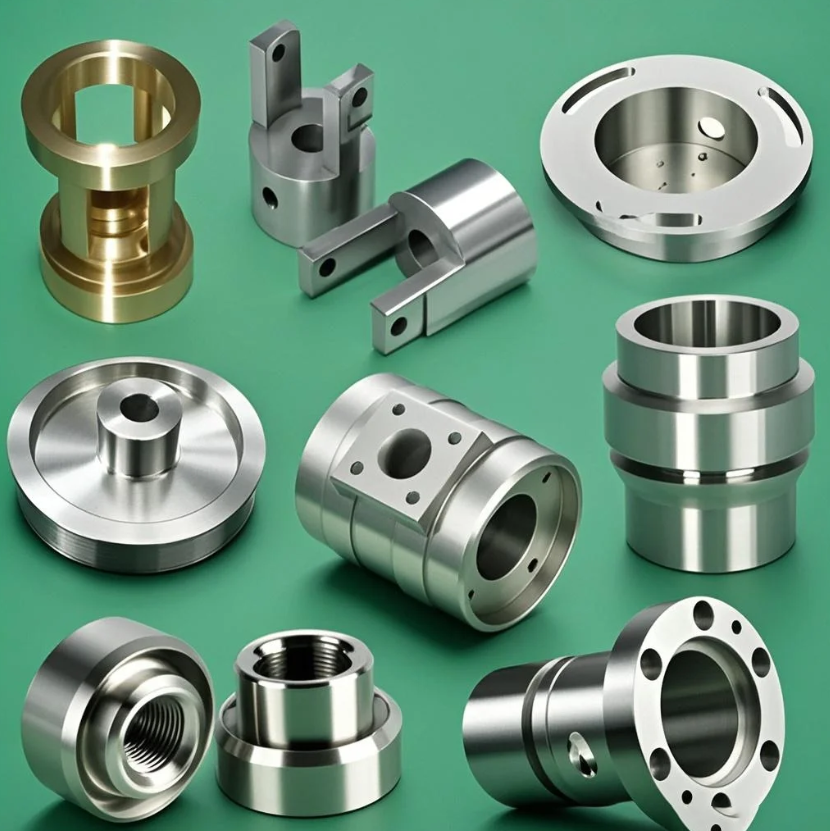
Safety-critical systems such as suspension, steering, and brakes depend on CNC-machined parts for stability, control, and responsiveness. Common components include control arms, tie rods, ball joints, steering knuckles, wheel hubs, brake calipers, brake rotors, brake brackets, and master cylinders. These parts require high strength and precise machining to withstand extreme forces, and CNC systems deliver the consistency needed to meet safety standards.
Interior and Exterior Components
CNC machining contributes to both the aesthetics and functionality of vehicle interiors and exteriors. Interior applications include dashboard panels, door handles, trim panels, instrument cluster components, and control module enclosures—machined to ensure precise cutouts for gauges, lights, and controls. Exterior components range from grilles, emblems, and body panels to exhaust manifolds, headers, catalytic converters, and mufflers. CNC machining enables intricate designs, fine details, and customized finishes (such as anodizing, electroplating, or laser marking) that enhance vehicle appeal.
Electrical and Custom Components
With the rise of automotive electronics and luxury tech features, CNC machining is increasingly used to produce precision electrical components like connectors, sensor housings, and wiring harnesses. These parts require tight tolerances to ensure proper connectivity and integration. Additionally, CNC machining supports customized modifications, including performance upgrades, aesthetic enhancements, and the integration of logos or serial numbers directly into part designs—catering to aftermarket demands and vintage car restorations.
Materials and Equipment for Automotive CNC Machining
Materials
CNC machining accommodates a broad range of materials to meet the diverse needs of auto part production:
- Metals: Aluminum (lightweight, heat-conductive), steel, stainless steel, titanium (high strength), copper, zinc alloy, and magnesium alloy.
- Plastics: ABS, PC, PE, POM, PP, acrylic (PMMA), nylon, bakelite, and silicone rubber.
- Other materials: Rubber and composites (with specialized machining techniques to address hardness or heat sensitivity).
Equipment
HLW leverages state-of-the-art CNC equipment to deliver high-quality auto parts, including:
- Multi-axis machining centers (3-axis, 4-axis, 5-axis, and 9-axis), enabling complex part production in single operations.
- CNC turning centers, milling machines, and drill/tap machines for precision shaping and drilling.
- Specialized equipment: Water jet cutters (for material-safe cutting), EDM (Electrical Discharge Machining) for tough conductive materials, high-speed engraving and milling machines, and industrial 3D printers (for hybrid manufacturing with CNC finishing).
- Testing and inspection tools: Coordinate Measuring Machines (CMMs), 2D measuring instruments, micrometers, hardness meters, and thread gauges—ensuring adherence to quality standards.
CNC Machining vs. 3D Printing in Automotive Applications
CNC machining and 3D printing (additive manufacturing) are complementary technologies, each with unique strengths in automotive production:
- CNC machining is a subtractive process (removing material from a solid workpiece), producing durable, high-strength parts with tight tolerances. It excels in mass production, complex metal components, and parts requiring superior surface finish.
- 3D printing is an additive process (layering material), offering faster prototyping, ultra-lightweight designs, and high customization. It is ideal for rapid design iterations and low-volume, complex plastic parts.
In practice, the two technologies are often integrated: 3D printing creates prototypes or complex structures, which are then finished with CNC machining to achieve precise tolerances and surface quality. For example, Ford and Volkswagen have used 3D printing for brake components and custom gear shifts, respectively, with CNC machining ensuring final precision.
Limitations of CNC Machining in Automotive Manufacturing
Despite its advantages, CNC machining faces certain limitations:
- High initial investment: Acquiring CNC machines, software, tooling, and skilled personnel requires significant upfront capital, which may be a barrier for small-to-medium enterprises.
- Design constraints: Undercuts, deep cavities, or internal features may be difficult to access with standard tools, requiring specialized equipment or additional operations.
- Production time for complex parts: Intricate components may require multiple machining steps, leading to longer cycle times compared to simpler parts.
- Material restrictions: High-temperature alloys or advanced composites may pose challenges due to hardness, brittleness, or heat sensitivity, requiring specialized tooling or cutting strategies.
- Waste generation: Subtractive machining produces material waste (swarf), though optimization of toolpaths can minimize this.
- Skilled labor demand: Operating and programming CNC machines requires trained personnel, and shortages of qualified operators can be a challenge.
- Large-scale production efficiency: For extremely high-volume production, methods like die casting or injection molding may be more cost-effective than CNC machining.
Future Trends of CNC Machining in the Automotive Industry
As the automotive industry evolves toward electrification, autonomous driving, digitalization, and sustainability, CNC machining is poised to adapt and remain a critical technology:
- Increased automation: Advancements in robotics, artificial intelligence (AI), and machine learning (ML) will further reduce manual intervention, enabling 24/7 production, real-time process optimization, and predictive maintenance.
- Advanced tooling and cutting technologies: Improved tool coatings, geometries, and high-speed machining techniques will enhance cutting speeds, tool life, and surface finish quality.
- Smart machining: IoT connectivity, sensor technologies, and AI algorithms will enable real-time monitoring of tool wear, material properties, and machining parameters—optimizing efficiency and reducing downtime.
- Sustainable manufacturing: CNC machining will adopt energy-efficient strategies, near-net shape machining, and optimized toolpaths to minimize material waste and energy consumption, aligning with environmental goals.
- Integration with additive manufacturing: Hybrid production processes combining 3D printing and CNC machining will become more prevalent, leveraging the strengths of both technologies for complex, high-quality parts.
- EV-focused innovation: As EV adoption grows (projected to reach 25% of global vehicle production by 2030), CNC machining will play a key role in manufacturing EV-specific components such as battery housings, cooling plates, and electric motor parts.
HLW’s CNC Machining Services for Auto Parts
HLW is a trusted provider of CNC machining services tailored to the automotive industry, offering end-to-end solutions from prototyping to large-scale production. With ISO 9001:2015 and ISO 14001:2015 certifications, HLW ensures the highest standards of quality and consistency.
Key Capabilities
- Multi-axis machining (3-axis, 4-axis, 5-axis, 9-axis) for complex part production.
- A broad range of materials: Metals, plastics, composites, and specialized materials like titanium and high-strength alloys.
- Comprehensive processing techniques: Turning, milling, drilling, EDM, water jet cutting, grinding, etching, and rapid prototyping.
- Customization and low-volume production: Supporting one-off parts, vintage car restorations, and aftermarket modifications.
- Fast lead times: Delivery in 3–15 days, with a daily production capacity of up to 10,000 pieces.
Quality Assurance
HLW implements a rigorous quality control process, including:
- Pre-manufacturing technical assessments to identify design flaws.
- Material verification (heat number, grade, dimensions, and specifications).
- In-process inspection with on-machine probes and first-article inspection.
- Post-production testing using CMMs and other precision instruments.
- Full-dimensional inspection reports available upon request.
Contact Information
For inquiries, quotes, or technical support, contact HLW:
- Phone: 18664342076
- Email: info@helanwangsf.com
- Services: Prototype development, mass production, custom machining, delivery (local and nationwide shipping), and after-sales support (online technical consulting, product return/replacement for quality issues).
In conclusion, CNC machining is a cornerstone of modern automotive manufacturing, delivering the precision, efficiency, and versatility needed to meet the industry’s evolving demands. As vehicles become more advanced, electric, and customized, CNC machining—supported by innovations in automation, smart technology, and sustainable practices—will continue to drive progress, with providers like HLW leading the way in delivering high-quality, reliable auto parts.