Introduction
CNC machining of gears is a precision manufacturing workflow that uses computer numerical control systems to shape, refine, and finish gear tooth geometry across multiple stages. Unlike basic gear cutting, CNC gear machining ensures consistent load distribution, low noise, minimal vibration, and long service life in mechanical transmission systems. It delivers repeatable precision from prototype to mass production, making it indispensable for high-performance gear applications.
What Is CNC Gear Machining?
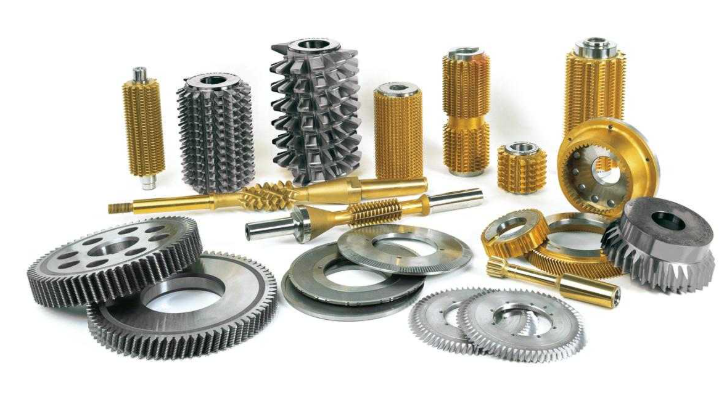
CNC gear machining is a multi‑operation process that controls critical parameters beyond nominal dimensions: tooth profile accuracy, pitch consistency, surface finish, and contact pattern. Even tiny deviations in tooth geometry cause stress concentration, heat buildup, noise, and premature failure. CNC systems stabilize tool motion, axis synchronization, and interpolation to minimize errors, ensuring gears perform reliably over millions of load cycles.
Core CNC Gear Cutting Processes
Primary Tooth Generation
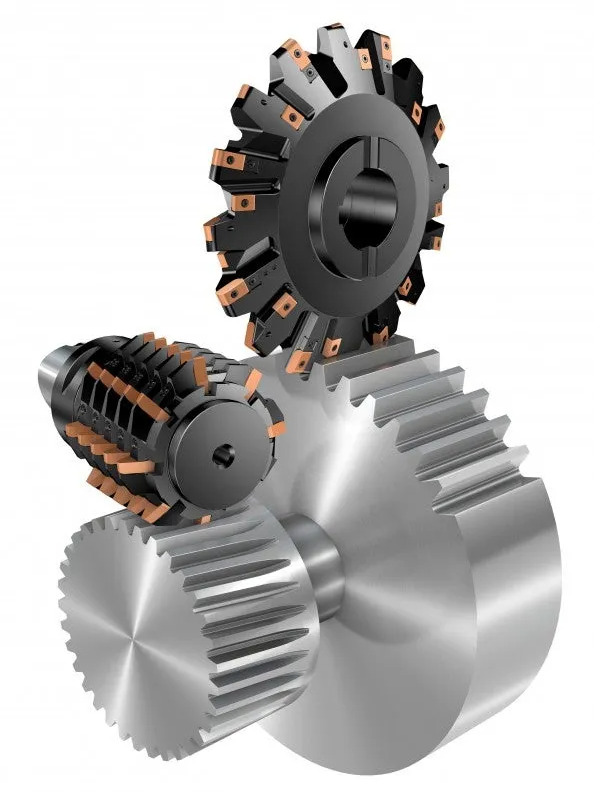
- Gear Hobbing: The most efficient method for high-volume external gears. The hob and blank rotate synchronously for consistent tooth spacing and pitch accuracy. Ideal for spur, helical, and worm gears.
- Gear Shaping: Uses a reciprocating pinion cutter. Suited for internal gears, shoulder‑restricted designs, and custom parts hobbing cannot handle.
- Broaching: Forms all teeth in one pass with a progressive tool. Delivers high accuracy and fast cycle times but requires costly tooling for high-volume standard gears.
- Power Skiving: A continuous cutting method faster than shaping and more flexible than broaching, especially efficient for internal gears and near‑shoulder features.
Tooth Refinement & Finishing
- Gear Shaving: Removes small material amounts pre‑heat treatment to improve profile and pitch, cost‑effective for soft materials.
- Gear Honing: Enhances surface texture and corrects minor geometry errors post‑heat treatment, widely used for low‑NVH automotive transmissions.
- Gear Grinding: The highest‑precision refinement process. Corrects heat‑treatment distortion and achieves tight tolerances for profile, lead, and surface finish, essential for high‑speed and high‑load gears.
Supporting CNC Operations
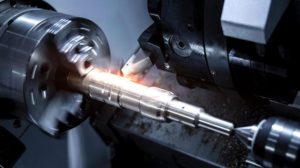
Precision turning establishes gear blank concentricity and mounting surfaces. CNC milling creates keyways, hubs, and complex interfaces. Drilling and tapping add mounting features with tight positional accuracy relative to gear teeth. These operations directly impact assembly fit and operational stability.
Complete CNC Gear Machining Workflow
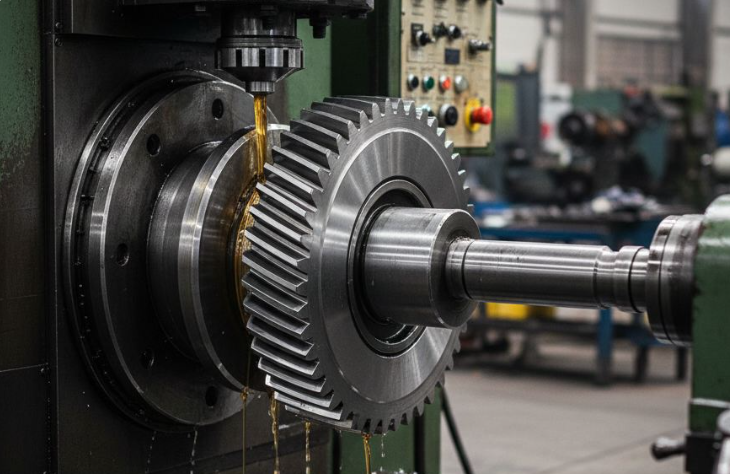
- Blank Preparation: CNC turning sets bore, faces, and outer diameter; concentricity prevents runout and uneven contact.
- Primary Tooth Cutting: Choose hobbing, shaping, broaching, or skiving based on gear type, volume, and geometry.
- Heat Treatment: Boosts strength and wear resistance but introduces distortion; process allowances compensate for changes.
- Tooth Refinement: Shaving, honing, or grinding corrects errors and optimizes contact patterns.
- Secondary Machining: Milling, drilling, and tapping completed before final finishing to avoid runout.
- Inspection & Verification: Measures profile, lead, pitch, and runout with specialized gear metrology equipment.
Key Factors Affecting Gear Machining Accuracy
- Tooth Profile Control: Involute geometry, tool consistency, CNC interpolation, and profile modifications (crowning, tip relief) determine load sharing and noise.
- Machine Rigidity & CNC Performance: Spindle stiffness, axis backlash, thermal stability, and rotary‑linear synchronization prevent micron‑level deflection.
- Material & Heat Treatment: Machinability, distortion tendency, and grindability dictate process planning for case‑hardened, through‑hardened, or powder metallurgy materials.
Industrial Applications of CNC Gear Machining
Industrial Machinery & Power Transmission
Gears for conveyors, crushers, gearboxes, and heavy pumps require high load capacity, uniform contact, and stable pitch accuracy. CNC machining enables profile corrections for shaft misalignment and continuous operation.
Automotive & Precision Motion Control
Used in transmission, differential, steering, servo, and actuator gears. CNC control delivers low NVH, tight backlash, and high positional accuracy for smooth response and drivetrain quality.
Aerospace, New Energy, & Precision Instruments
Aerospace engine gears, wind turbine gears, new energy motor gears, robot micro‑gears, and medical instruments demand micron‑level precision, high‑strength material processing, and lightweight design.
Prototyping & Low‑Volume Custom Gears
CNC flexibility supports one‑off parts, legacy replacements, and special robotics/test rig gears without dedicated tooling, shortening iteration cycles and validation time.
When CNC Gear Machining Is Not Optimal
- High‑volume commodity gears (appliances, consumer products): Dedicated hobbing, molding, or powder metallurgy offer lower per‑unit cost.
- Light‑duty, non‑load‑bearing parts (timing mechanisms, manual adjusters): Basic cutting or stamping meets requirements without extra precision cost.
Advantages of CNC Gear Machining vs. Conventional Methods
- Superior Accuracy & Consistency: Micron‑level errors controlled digitally; batch consistency minimizes assembly issues.
- High Efficiency & Flexibility: Fast program switching for multi‑variety small‑batch or medium‑volume production.
- Complex Geometry Capability: Handles non‑standard, special‑shaped, and internal gears with multi‑axis synchronization.
- Cost Efficiency: Optimized tool paths reduce material waste; lower rejection and labor costs long‑term.
Conclusion
CNC machining of gears is a foundational technology for precision power transmission. By integrating cutting, refinement, heat treatment planning, and supporting operations, it delivers reliable, low‑noise, long‑life gears for automotive, industrial, aerospace, and custom applications. Choosing the right CNC processes and workflow ensures performance, efficiency, and cost balance across production volumes.
Contact HLW for Custom CNC Gear Solutions
For high‑precision custom gear manufacturing, prototype development, and production‑scale CNC gear machining, contact HLW today.
Tel: +86 18664342076
Email: info@helanwangsf.com
We provide end-to-end CNC gear solutions with strict accuracy control and consistent quality for your critical transmission applications.