Gia công CNC khối lượng lớn: Hướng dẫn thực hành toàn diện
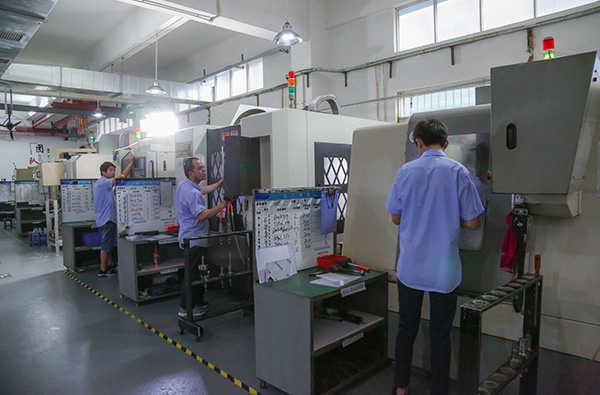
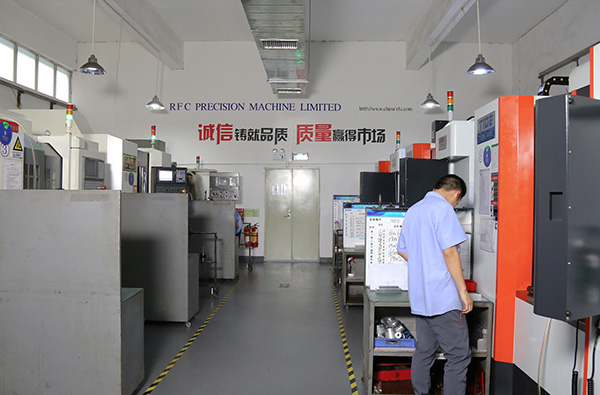
High volume CNC machining (also called repetition engineering) is automated, repeatable production of precision parts at scale. This is not prototyping. The goal is not flexibility — it is throughput, repeatability, and per-part cost.
What Counts as High Volume?
Industry standard volume tiers:
- Low volume: 1–100 parts (prototyping, validation)
- Mid volume: 100–1,000 parts (transition phase)
- High volume: 1,000 to 1,000,000+ parts (full production)
There is a myth that CNC is only for prototypes. That is wrong. When parts require tight tolerances, exotic materials, or the design is still iterating (making hard tooling risky), CNC stays cost-competitive well into the tens of thousands. Ô tô, y tế, và hàng không vũ trụ run millions of CNC parts because molding and casting simply cannot hit the required precision.
High Volume vs. Low Volume: Not the Same Game
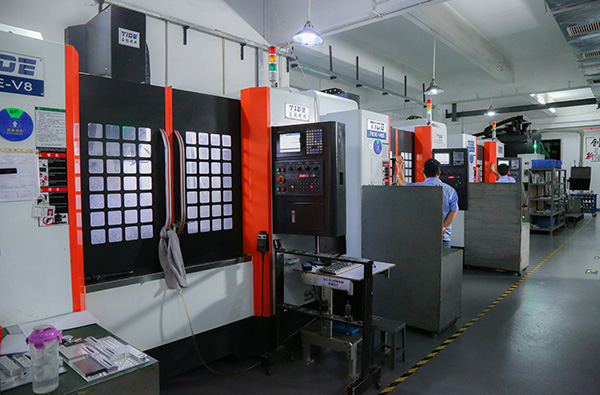
A shop that does excellent prototypes will often crash and burn on production. The priorities are completely different:
- Primary goal: Low volume = flexibility, fast turns; High volume = stability, uptime, output
- Equipment focus: Low volume = universal VMCs, quick changeover; High volume = dedicated machines, minimal changeover
- Workholding: Low volume = vises, manual clamping; High volume = custom hydraulic/pneumatic fixtures, multi-station setups
- Labor dependency: Low volume = skilled machinist tweaks; High volume = program and system driven, operator-proof
- Tool strategy: Low volume = run until broken; High volume = predictable life management, forced changes
- Quality approach: Low volume = inspect when done; High volume = in-process monitoring, SPC
The big one is tool wear. On 10 parts, you do not notice it. On 10,000 parts, tool wear causes dimensional drift that will scrap whole batches if you do not compensate systematically. You cannot eyeball this.
1. Cost Drops Hard at Scale
This is the most obvious advantage. Programming, fixturing, first article inspection — these are all Non-Recurring Engineering (NRE) costs. They do not change whether you run 100 or 100,000 parts.
Simple example with $3,000 NRE (programming + fixtures):
- 10 parts: $300/part NRE
- 100 parts: $30/part NRE
- 10,000 parts: $0.30/part NRE
Add bulk material discounts, reduced changeover time, and automation cutting labor, and per-part cost can drop 50–80% vs. low volume runs.
2. True Consistency Across the Entire Run
The real value of CNC is not making one perfect part — it is making 10,000 identical parts. Once the program is proven, fixtures are repeatable, and tool compensation is dialed in, part 1 and part 100,000 can be within microns of each other.
That is non-negotiable for medical, aerospace, and automotive. Nobody ships parts with batch-to-batch variation in those industries.
3. Tolerance Capability That Molding Cannot Touch
Injection molding and die casting win on per-part cost at very high volumes, but they hit a hard ceiling on precision. Production CNC routinely holds:
- Standard tolerance: ±0,01 mm
- Precision tolerance: ±0.0025 mm (±0.0001 in)
- Critical features: Down to ±1 micron on specific dimensions
And CNC does not care about material. Steel, aluminum, titanium, brass, engineering plastics — all run on the same machines, no tooling change required.
4. Design Flexibility Without the Tooling Bill
This is the hidden advantage over molding and casting. A hard injection mold costs tens of thousands and takes weeks to modify. A CNC program change takes hours. If your product is still evolving, or you expect engineering changes, CNC de-risks the entire program. This is why medical and electronics companies keep parts on CNC long after they hit “production” volumes.
Equipment That Actually Runs Production
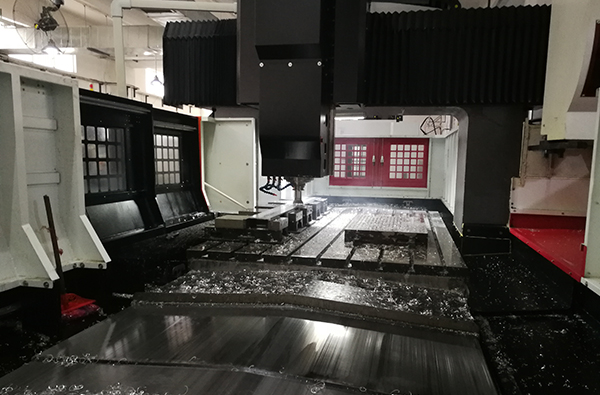
Not every CNC machine is built for 24/7 production. A prototype shop full of VMCs is not a production shop.
Horizontal Machining Centers (HMC) — The workhorse of production milling. Compared to verticals:
- Dual or multi-pallet systems: machine and load simultaneously, 90%+ spindle uptime
- Gravity chip evacuation — no chip recutting causing size drift
- Higher rigidity for aggressive, long-run material removal
- Tombstone fixturing for multiple parts per cycle
Swiss-Type Lathes — The king of small, precision turned parts. With bar feeders, these run unattended for 30+ hours straight. They do turning, milling, drilling, and tapping in one setup. Typical parts: medical implants, precision shafts, connectors, sensor components. They hold ±0.005 mm all day, every day.
Multi-Spindle Machines — Efficiency monsters. Where a standard lathe does one part at a time, multi-spindles run 6–8 parts simultaneously. Cycle times get cut to a fraction. The machine costs ~30% more but delivers 500% throughput. Used for simple, extremely high volume components.
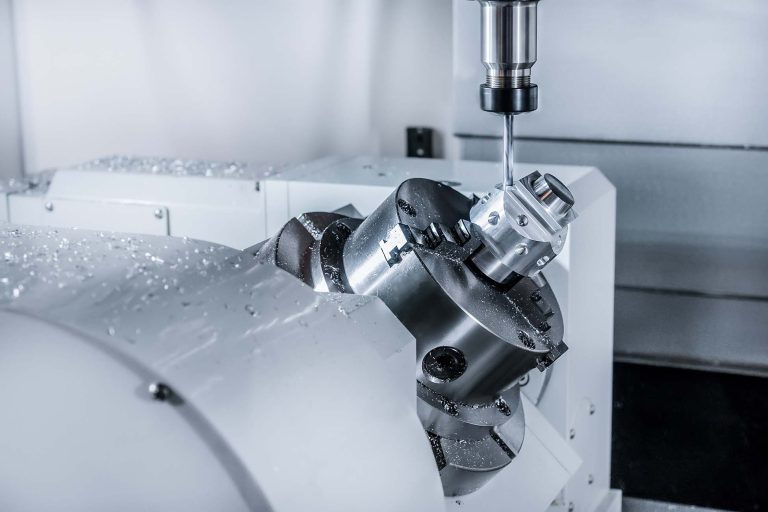
5-Axis Machining Centers — For complex geometry in production. The value is reduced setups — one chucking instead of five, eliminating tolerance stack-up. In production, these are almost always paired with pallets or robotic loading to keep spindles running.
Automation: Where Production Actually Happens
This is what separates production from prototyping:
- Bar feeders: continuous turning without manual stock loading
- Pallet changers: operator loads/unloads while spindle cuts
- Robotic machine tending: 6-axis robots move parts between machines, run lights out
- Automatic tool changers with sister tooling: redundant tools swap at end of life, no downtime
- In-machine probing: measures parts on the machine, compensates for tool wear and thermal drift
The end state is lights-out manufacturing — machines run nights and weekends with nobody in the building. This is not science fiction; it is standard practice in mature production shops.
Các quy trình gia công cơ bản
Phay CNC — For housings, brackets, plates, covers, and structural parts. Production milling is not the same as prototype milling: use High Efficiency Milling (HEM) strategies, treat tool life as the primary metric (not maximum speed), use multi-part fixtures to minimize air cutting, and prefer HMCs over VMCs for rigidity and chip control.
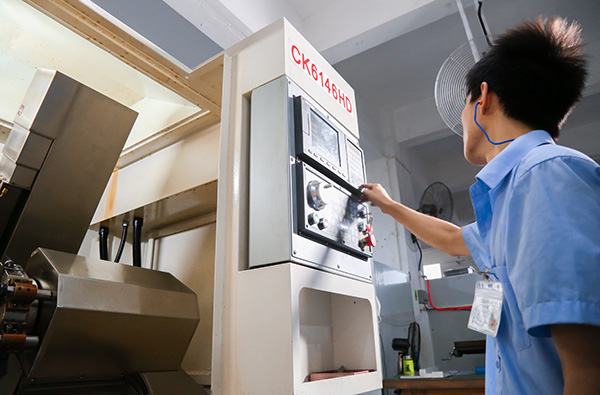
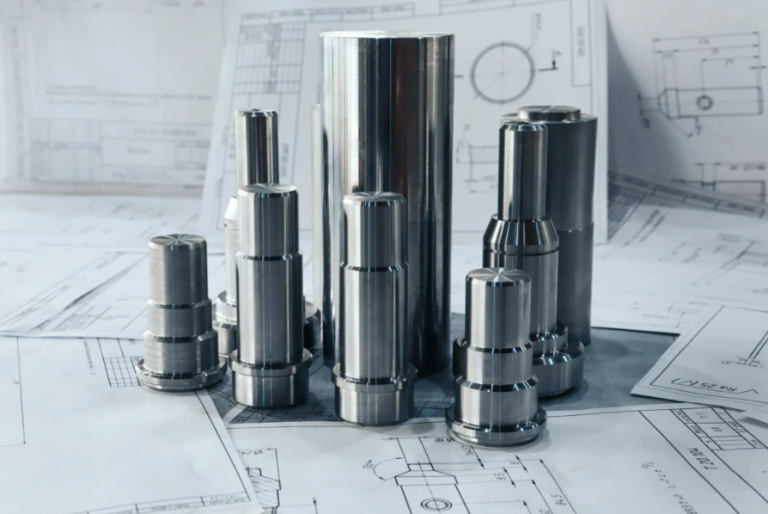
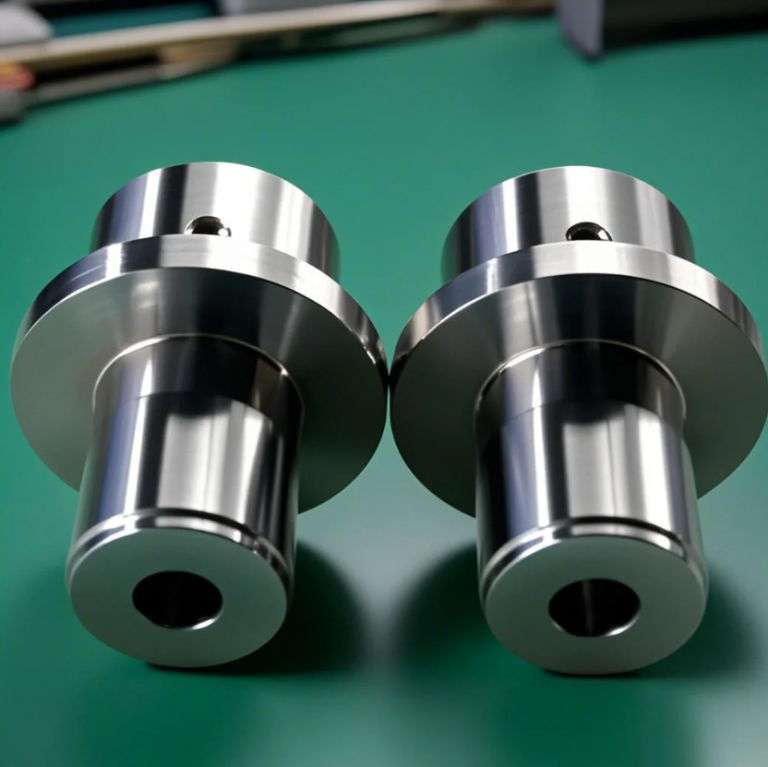
Tiện CNC — For shafts, bushings, pins, flanges — any rotational part. Production turning uses live tooling and sub-spindles to complete parts in one setup. Do not use a machining center for turning work — dedicated lathes are faster, cheaper, and more accurate for cylindrical parts.
CNC Drilling — For parts with dense hole patterns (manifolds, engine blocks, electronics housings), production shops often offload drilling to dedicated machines. Drilling tools wear fast; isolating the operation keeps main machines running. Through-tool coolant and peck optimization extend tool life and improve hole quality.
Specialized Operations — Real production shops integrate secondary operations to eliminate re-fixturing:
- Thread rolling: 30% stronger threads than tapping, chipless, faster
- Broaching: internal splines and keyways in one pass
- Hard turning: turn hardened steel, replace some grinding operations
- In-process probing: real-time measurement with automatic offset adjustment
Fixturing: The Hidden Production Killer
Most engineers ignore fixturing. In high volume, fixturing makes or breaks cost, quality, and delivery. A vise works for 10 parts. For 10,000, you need purpose-built workholding.
Fixture design principles for production:
- 3-2-1 Location: Six hardened locating points fully constrain all six degrees of freedom. Every part loads in exactly the same position.
- Controlled Clamping: Hydraulic or pneumatic clamps apply consistent force — no more variation from operator strength. Thin-wall parts use custom supports to spread clamping force and avoid deflection.
- Multi-Station: Tombstones and multi-part plates let you machine 4, 8, or more parts per cycle. Tool paths chain together, reducing tool changes and air time.
- Quick Change: Zero-point locating systems cut changeover from hours to minutes. Multiple part numbers can run on the same machine.
- Chip and Coolant Access: Fixtures must clear chips and allow coolant to hit the cutting zone. Chip buildup on locating surfaces destroys repeatability.
Good fixtures don’t just hold parts — they multiply throughput, guarantee consistency, and de-skill the job. On a 10,000-part run, 30 seconds saved per part is 80+ machine hours.
Holding Tolerances Across 10,000 Parts
Holding tolerance on one part is easy. Holding it across a full production run is a system problem.
Tool Wear Management — This is the #1 enemy in production. Every cut wears the tool a little. Over thousands of cycles, that adds up to drift. Mature shops:
- Build tool life schedules — force tool changes at predetermined counts or times
- Use coated tools (TiAlN, AlCrN) for heat and wear resistance
- Optimize feeds/speeds for constant chip load, reducing thermal shock
- Run sister tooling — redundant tools in the magazine that auto-swap at end of life
Thermal Drift — A machine running for hours heats up. Spindles, ballscrews, and castings expand. That drift can be 5–15 microns. For precision work: run warm-up cycles before production starts, use temperature-controlled shops for micron-level work, and deploy in-machine probing to measure drift and auto-compensate coordinates.
Kiểm soát quá trình thống kê (SPC) — This is how production quality actually works. You don’t inspect parts at the end — you measure sample parts through the run, plot dimensions on control charts, and watch trends. If dimensions start drifting toward a tolerance limit, you compensate before you make scrap. SPC drives defect rates down to PPM levels. End-of-run inspection cannot do that.
Inspection Methods:
- First Article Inspection (FAI): full dimensional check on the first part, non-negotiable
- In-machine probing: measure on the machine, compensate in real time
- Patrol inspection: check critical dimensions every hour or every N parts
- CMM: coordinate measuring machine for complex geometry arbitration
- Optical scanning: fast non-contact inspection of contours and surfaces
Material Selection: The Cost Lever Nobody Talks About
Pick the right material and you cut cost in half. Most engineers pick by strength alone. In production, machinability drives cost more than any other factor.
| Vật liệu | Đơn đăng ký | Khả năng gia công | Cost Index | Production Notes |
|---|---|---|---|---|
| Al 6061-T6 | Structures, housings | Tuyệt vời | 2 | The workhorse. Fast, predictable, great supply chain |
| Al 7075-T6 | Aerospace, high load | Trung bình | 3.5 | Strong but hard on tools; optimize parameters |
| Steel 1018 | General, shafts | Tốt | 1 | Cheapest structural steel, predictable cutting |
| Steel 1045 | Machine components | Trung bình | 1.2 | Better hardness than 1018 |
| Steel 4140 | Gears, spindles | Trung bình | 2 | Pre-hard; tool life monitoring critical |
| SS 303 | Fasteners, fittings | Good (best SS) | 3 | Production turning choice, way faster than 304 |
| SS 304 | Medical, food | Poor | 3.5 | Work hardens — sharp tools, aggressive feed |
| SS 316L | Marine, medical | Very poor | 4.5 | Slow cutting; budget cycle time accordingly |
| Brass C360 | Fittings, electrical | Tuyệt vời | 3 | Screws through; ideal for screw machines |
| Ti 6Al-4V | Aerospace, implants | Terrible | 10+ | Only for high-value parts; tooling is expensive |
| POM (Delrin) | Bushings, gears | Tuyệt vời | 1.5 | Best plastic for tight tolerances |
| PEEK | Medical, high temp | Trung bình | 10+ | High performance, high cost |
Four Hard Rules for Production Material:
- 6061 is king. Unless you have a specific reason, use 6061. It is faster, cheaper, easier on tools, and available everywhere. Stop defaulting to 7075.
- Free-machining grades save real money. 303 stainless cuts twice as fast as 304 with 3x tool life. If corrosion requirements are not extreme, 303 is the production choice for turned parts.
- Don’t over-specify. 4140 vs 1045 — many applications don’t need the alloy, but 4140 costs 50% more to machine. Run a material downgrade analysis before locking in specs.
- Machinability compounds. A 10% improvement in machinability reduces tool cost, machine time, energy, and scrap across the entire run. That is leverage.
Recommended by industry:
- Automotive: 6061, 6082, 1045, 4140
- Aerospace: 7075, 2024, 17-4PH, Ti-6Al-4V
- Medical: 316L, 17-4PH, PEEK
- Electronics: C360 brass, 6061, C110 copper
- Industrial: 1018, 1045, 4140
How Cost Actually Breaks Down
Amateurs quote material. Professionals quote machine time. Here is where the money goes in production CNC:
Non-Recurring (One-Time):
- Programming: CAM, post-processing, prove-out
- Fixtures: custom workholding, hydraulic systems, locating pins
- First article: FAI, test cuts, process optimization
- Special tooling: form cutters, custom drills
These costs don’t change with quantity. At 100 parts, NRE might be 25% of total cost. At 10,000 parts, it is under 1%.
Recurring (Per-Part):
- Material: bar/plate cost, less with bulk discounts
- Machine time: cycle time x hourly rate — this is the big one
- Tooling: per-part tool consumption, material-dependent
- Labor: loading, inspection, deburring — less with automation
- Finishing: anodize, plate, powder coat, heat treat
- Quality: inspection, SPC, scrap allowance
Where to attack cost in production:
- Cycle time optimization. 10 seconds per part = 28 machine hours on a 10k run.
- Reduce changeover. Dedicated setups, zero-point fixturing.
- Automate loading. Robots and pallets cut direct labor.
- Material buying power. Bulk orders get better pricing.
- Pick the right material. Machinability beats material price every time.
CNC vs. Other Production Processes
High volume is not only CNC. Know when to use what.
CNC vs. Injection Molding:
- Molding wins: plastic parts at 5,000–10,000+, complex geometry, as-molded surface
- CNC wins: tight tolerances, no tooling lead time, design changes, low/medium volume
- Rule of thumb: if the design is frozen and volume is there, mold it. If tolerances are tight or revisions are likely, CNC it.
CNC vs. Die Casting:
- Casting wins: non-ferrous metal parts at very high volume, thin walls, complex shapes
- CNC wins: strength (castings have porosity), tight tolerances, material variety, no tooling
- Reality check: most die castings get CNC secondary operations on critical dimensions anyway. The question is how much stock to leave.
When CNC is the only choice for production:
- Tolerances tighter than ±0.05 mm on critical features
- Exotic materials: titanium, superalloys, specialty stainless
- Unstable design — engineering changes expected
- Volumes from 1k–50k where tooling amortization doesn’t pencil out
- 100% pressure tightness or structural requirements castings can’t meet
Hybrid Processes: The Sweet Spot for Cost
Nobody cuts 100,000 parts from solid billet if they are smart. The real cost play is near-net-shape + CNC finishing. Use a process that gets you close to final geometry, then CNC only the critical features. You keep CNC precision but slash material removal and cycle time.
Near-net-shape options:
- Die casting: aluminum/zinc complex parts, leave 0.3–0.5mm stock for CNC
- Forging: high-strength structural parts, crankshafts, connecting rods; grain flow adds strength
- Powder metallurgy: gears, structural parts; minimal stock removal
- MIM (Metal Injection Molding): small complex steel parts, better precision than casting
- Additive manufacturing: parts with internal features, complex geometry; finish machine critical surfaces
Above 100,000 parts, always evaluate hybrid approaches. Machining from solid at those volumes means 80%+ of your material becomes chips. That is wasted money and wasted time.
How to Vet a Production CNC Shop
This is where most programs fail. A shop that quotes cheap prototypes will destroy your production schedule. Here is what to actually check:
1. Look at the equipment, not the website
- Do they have HMCs, Swiss lathes, multi-spindles? Or just VMCs?
- Is there actual automation? Bar feeders, pallets, robots? Or guys loading parts by hand?
- How old are the machines? What is the maintenance schedule?
- Do they have CMM, SPC software, in-machine probing?
A shop with 5 VMCs and zero automation cannot run 100k parts. They will take your order and broker it out.
2. Quality systems
- ISO 9001 is baseline. Automotive wants IATF 16949. Aerospace AS9100. Medical ISO 13485.
- Do they run SPC, or just inspect at the end?
- Can they provide FAI reports, material certs, inspection data?
- How do they manage tool life? Is there documented process control?
3. Relevant experience
The production learning curve is expensive. If a shop hasn’t run your material and your tolerance class before, they will learn on your dime — high scrap, slow cycles, missed deliveries. Find someone who has already made similar parts at similar volumes.
4. Capacity and flexibility
- What is their current spindle utilization? Do they actually have bandwidth?
- Can they double volume if needed? How fast?
- What is the backup plan if a machine goes down?
5. Engineering and communication
Stuff goes wrong in production — tool wear, material variation, drift. You want a shop with process engineers who catch problems and adjust, not a shop that calls you after they have made 2,000 bad parts. Can you talk directly to the engineer running your job? If you can only reach sales, that is a red flag.
6. Prototype-to-production continuity
Use the same shop that prototyped for production if possible. They already figured out the fixtures, tools, and parameters. Switching shops at production means re-validating everything from scratch.
Ứng dụng trong ngành
- Automotive: Engine components, transmission parts, brackets, housings, fuel system parts. Tight tolerances, high consistency, 10k–100k annual volumes.
- Aerospace: Structural components, engine parts, hydraulic components, landing gear hardware. Titanium, high-temp alloys, 7075 aluminum. Full traceability, extreme tolerance requirements.
- Medical: Surgical instruments, implants, device housings, dental components. Stainless, titanium, PEEK. ISO 13485, lot traceability, finish requirements.
- Electronics: Connectors, heat sinks, precision brackets, optical components. Small features, tight tolerances, cosmetic requirements, very high volumes.
- Industrial Equipment: Gears, shafts, bearing housings, hydraulic valve bodies. Heavy section, durable, repeatable.
- Defense: Weapon system components, vehicle parts, safety equipment. Mil-spec standards, reliability over cost.
- Oil & Gas / Mining: Valve bodies, fittings, wear parts. High pressure, corrosive environments, heavy sections.
Where This Is Heading
Production CNC is not standing still:
- AI and Machine Learning: Monitor spindle load, vibration, acoustics to predict tool wear and machine failures before they happen.
- More Automation: Robots don’t just load parts — they deburr, clean, and inspect. Entire cells run unattended.
- Sản xuất kết hợp: 3D printing + CNC, casting + CNC, forging + CNC. Combining processes for optimal cost and performance.
- New Materials: Composites, ceramics, superalloys becoming more common as tooling and techniques improve.
- Digital Twin: Simulate programs and fixtures virtually before cutting metal, reducing prove-out time and scrap.
Câu hỏi thường gặp
Q: What quantity counts as “high volume” for CNC?
A: Typically 1,000+ parts, but it depends on complexity. Simple parts can be production at a few hundred; complex large parts might not hit “production” until 5,000+.
Q: What tolerances can production CNC hold?
A: Standard is ±0.01 mm. Precision features hit ±0.0025 mm. Critical dimensions can go to ±0.001 mm. Don’t over-tolerance — every micron costs money.
Q: CNC vs. die cast + CNC — when is each cheaper?
A: Below 10,000 aluminum parts, CNC from solid often wins because die cast tooling is expensive. Above 100,000, casting + finish machining is almost always cheaper. Run the math on tooling amortization.
Q: Is first article inspection really necessary?
A: Yes. FAI is the last checkpoint before you commit to a full run. Skipping it is how you scrap entire batches.
Q: How do I reduce CNC production cost?
A: Priority order: (1) Optimize part design for machinability, (2) Select free-machining materials, (3) Improve fixturing to reduce load time, (4) Partner with a shop that has proper automation, (5) Negotiate material and tooling on volume. Machine time is the biggest cost. Don’t nickel-and-dime material.