
CNC Machining of Aluminum Alloy stands as a cornerstone of modern manufacturing, celebrated for its ability to produce lightweight, precise, and cost-effective components across industries. From aerospace to consumer electronics, its unique blend of machinability, strength, and corrosion resistance makes it a preferred material for engineers and manufacturers worldwide. This guide explores the fundamentals of aluminum alloy CNC machining, including material selection, key processes, optimization strategies, and industry applications—supported by insights from HLW, a leading provider of precision machining services.
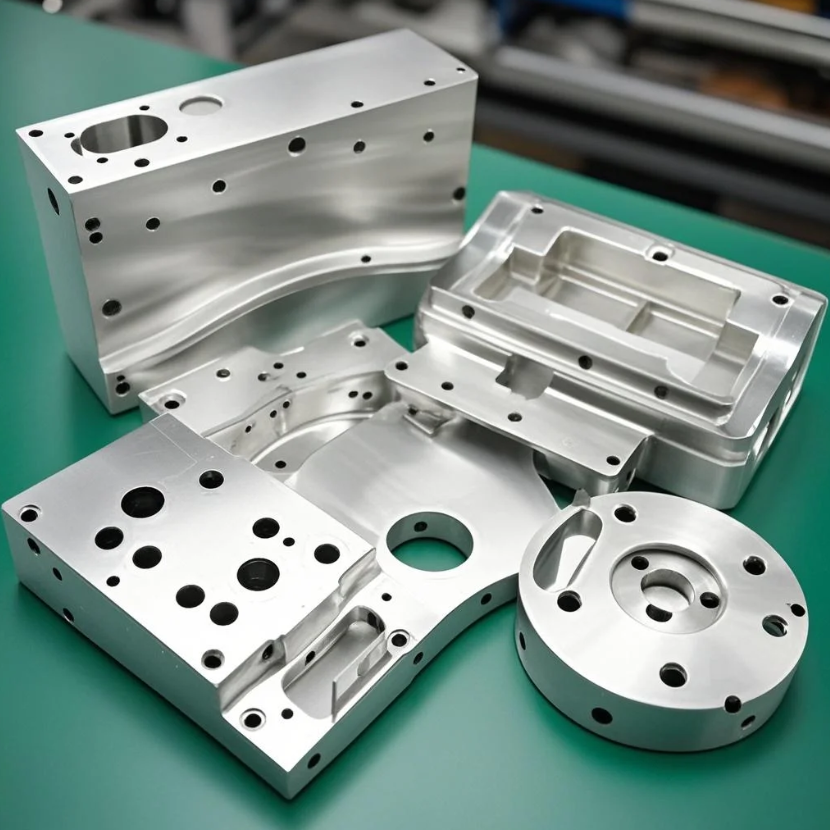
1. Introduction to Aluminum: Source, Properties, and Advantages
Aluminum is the most abundant metallic element in the Earth’s crust, primarily extracted from bauxite ore through a two-step process:
- Bayer Process: Crushes bauxite, mixes it with caustic soda, and filters to extract alumina (aluminum oxide).
- Electrolysis: Dissolves alumina in a fluorinated bath, using an electric current to produce pure aluminum, which is then cast into billets, sheets, or rods for machining.
Its standout properties for CNC machining include:
- Exceptional Strength-to-Weight Ratio: ~1/3 the weight of steel while maintaining sufficient strength for structural parts.
- High Machinability: Cuts 3–4 times faster than steel or titanium, reducing cycle times and tool wear.
- Corrosion Resistance: Forms a natural oxide layer; additional treatments (e.g., anodizing) enhance durability.
- Thermal/Electrical Conductivity: Ideal for heat sinks, electronics housings, and conductive components.
- Sustainability: 100% recyclable, aligning with green manufacturing goals.
2. What is CNC Machining?
CNC (Computer Numerical Control) machining automates material removal using preprogrammed software, replacing manual operation. It offers:
- Precision: Tolerances as tight as ±0.005 mm (critical for aerospace/medical parts).
- Consistency: Reduces human error for batch production.
- Versatility: Handles complex geometries via multi-axis machines (3–5 axes are most common; HLW offers 4–5 axis capabilities).
Key CNC machines for aluminum include:
- CNC Milling Machines: Rotate cutting tools to shape stationary aluminum blocks (ideal for irregular, 3D parts like brackets or engine components).
- CNC Turning Machines: Spin aluminum stock while a fixed tool trims material (for cylindrical parts: shafts, bushings).
- Specialized Cutters: Plasma cutters (thick aluminum up to 6 inches), laser cutters (thin sheets, high precision), and water cutters (no heat distortion, suitable for sensitive parts).

3. CNC Machining of Aluminum Alloy
Pure aluminum is too weak for most applications; alloys (blended with copper, magnesium, or zinc) enhance performance. The most common grades for CNC machining are:
| Alloy | Key Properties | Applications | Machinability | Cost |
|---|---|---|---|---|
| 6061-T6 | Balanced strength, corrosion resistance | Automotive brackets, bicycle frames, enclosures | Excellent | Low |
| 7075-T6 | Aerospace-grade strength (highest among alloys) | Aircraft wings, racing parts, load-bearing structures | Moderate | High |
| 5052-H32 | Superior corrosion resistance | Marine parts (hulls, deck plates), fuel tanks | Good | Medium |
| 2024-T3 | High fatigue resistance | Aircraft fuselages, military vehicle parts | Moderate | Medium |
| 2011 | Ultra-high machinability | Intricate parts (gears, fittings) | Excellent | Medium |
| 1100 | Purest alloy (99% Al), high conductivity | Food processing equipment, decorative parts | Good | Low |
HLW recommends matching alloys to application needs: e.g., 6061 for prototypes, 7075 for high-stress parts, and 5052 for marine environments.
4. Aluminum vs. Steel: Key Comparisons
Choosing between aluminum and steel depends on project goals:
| Factor | Aluminum | Steel |
|---|---|---|
| Weight | Light (2.7 g/cm³) | Heavy (7.8 g/cm³) |
| Machinability | Fast, low tool wear | Slow, high tool wear |
| Corrosion Resistance | Natural oxide layer; no coating needed | Requires painting/coating (except stainless) |
| Cost | Higher raw material (stainless steel is pricier) | Lower for mild/carbon steel |
| Strength | Good (alloy-dependent) | Superior (for heavy-load parts) |
5. Best Practices for Aluminum CNC Machining
HLW leverages 15+ years of experience to optimize aluminum machining, focusing on:

5.1 Tool Selection
- End Mills: 2-flute (max chip clearance), 3-flute (balance of speed/strength), or high-helix tools (pull chips upward).
- Tool Material: Carbide (preferred for production; resists heat) vs. HSS (for low-volume, soft alloys).
5.2 Cutting Parameters
- High Spindle Speeds: 1,000–5,000 RPM (avoids tool rubbing).
- Adequate Coolant: Flood coolant or air blasts prevent chip welding and heat buildup.
5.3 Design for Manufacturability (DFM)
- Avoid sharp internal corners (use radii ≥1/3 cavity depth).
- Limit cavity depth to ≤4x width (reduces machining time).
- Maintain wall thickness ≥1 mm (prevents vibration/deformation).
- Use standard hole sizes (reduces tool changes).
5.4 Quality Control
- Inspection Tools: CMM (Coordinate Measuring Machines) for dimensional checks; surface roughness testers (Ra 0.8–1.6 μm achievable).
- Post-Processing: Anodizing (Type II/III for wear resistance), bead blasting (matte finish), or powder coating (aesthetics).
6. Applications Across Industries
Aluminum CNC machining serves diverse sectors, powered by HLW’s precision capabilities:
- Aerospace/Automotive: Lightweight parts (wing skins, engine brackets) to improve fuel efficiency.
- Consumer Electronics: Smartphone/laptop housings (sleek finish, EMI shielding).
- Robotics/Automation: Low-inertia components (robot arms, linear guides) for responsiveness.
- Medical Devices: Biocompatible parts (surgical tools, diagnostic equipment) with easy sterilization.
- Marine: Corrosion-resistant parts (hulls, fasteners) for saltwater environments.
7. HLW’s CNC Machining Services
HLW is a trusted provider of aluminum CNC machining, offering:
- Capabilities: 4–5 axis milling, turning, drilling, and surface finishing (anodizing, plating).
- Quality: ISO 9001/IATF 16949 certified; 99% perfect part delivery rate.
- Production Capacity: 100,000+ parts/month (supports prototypes to large-scale runs).
- Support: DFM reviews, free sampling, and after-sales service (replacement for defects).
Contact HLW for custom solutions:
- Phone: 18664342076
- Email: info@helanwangsf.com
- Shipping: DHL/FedEx/UPS or sea freight; packaging (foam, cartons, wooden boxes) per customer request.
8. Conclusion
Aluminum alloy CNC machining combines efficiency, precision, and sustainability—making it indispensable for modern manufacturing. By selecting the right alloy, optimizing processes, and partnering with experts like HLW, manufacturers can unlock cost savings and superior part performance. Whether for aerospace innovation or consumer tech, aluminum CNC machining continues to drive progress in lightweight, high-quality production.
3 Supporting Images for the Article
Aluminum CNC Machining Process Flowchart
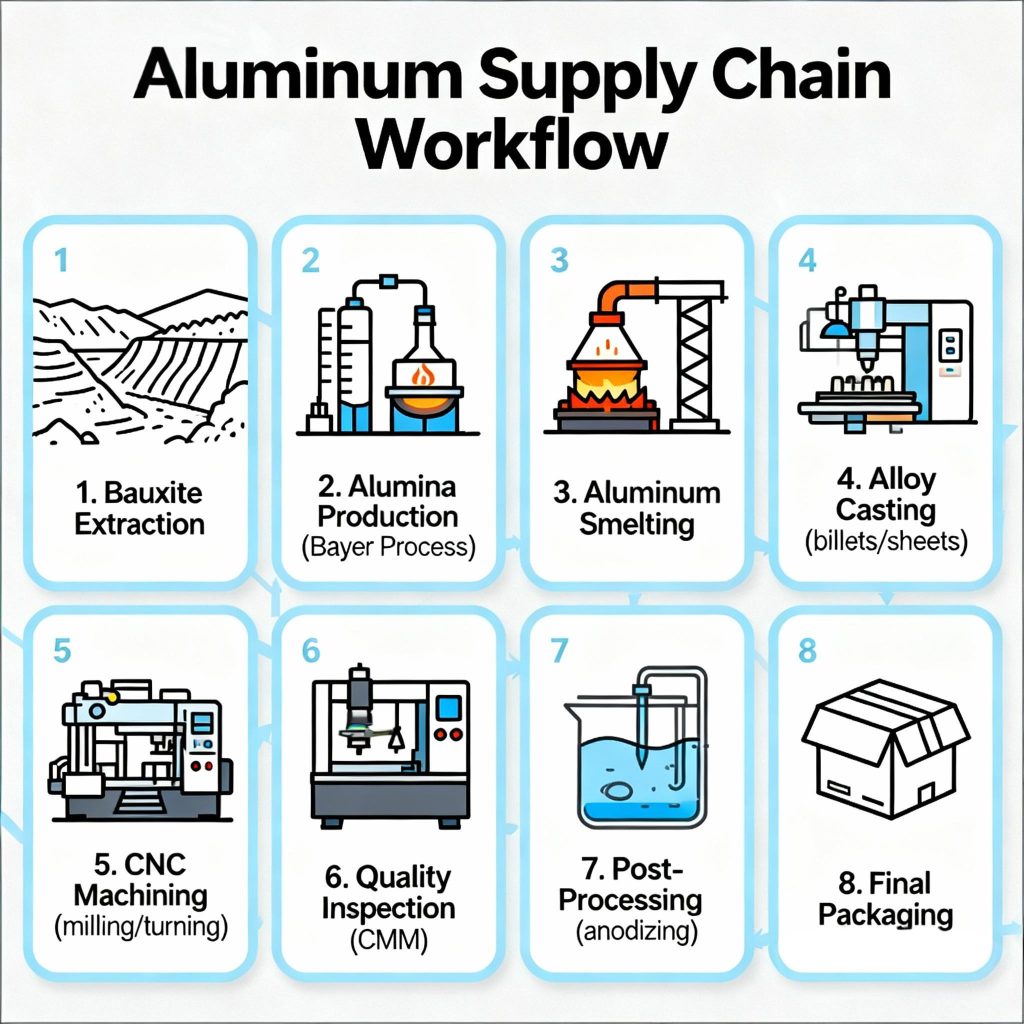
A step-by-step visual diagram showing the full workflow:
- Bauxite Extraction → 2. Alumina Production (Bayer Process) → 3. Aluminum Smelting → 4. Alloy Casting (billets/sheets) → 5. CNC Machining (milling/turning) → 6. Quality Inspection (CMM) → 7. Post-Processing (anodizing) → 8. Final Packaging.Purpose: Simplifies the supply chain for readers, highlighting key stages from raw material to finished part.