CNC Machining of Bevel Gears
CNC Machining of Bevel Gears: Mastering Precision on Multi-Axis Centers
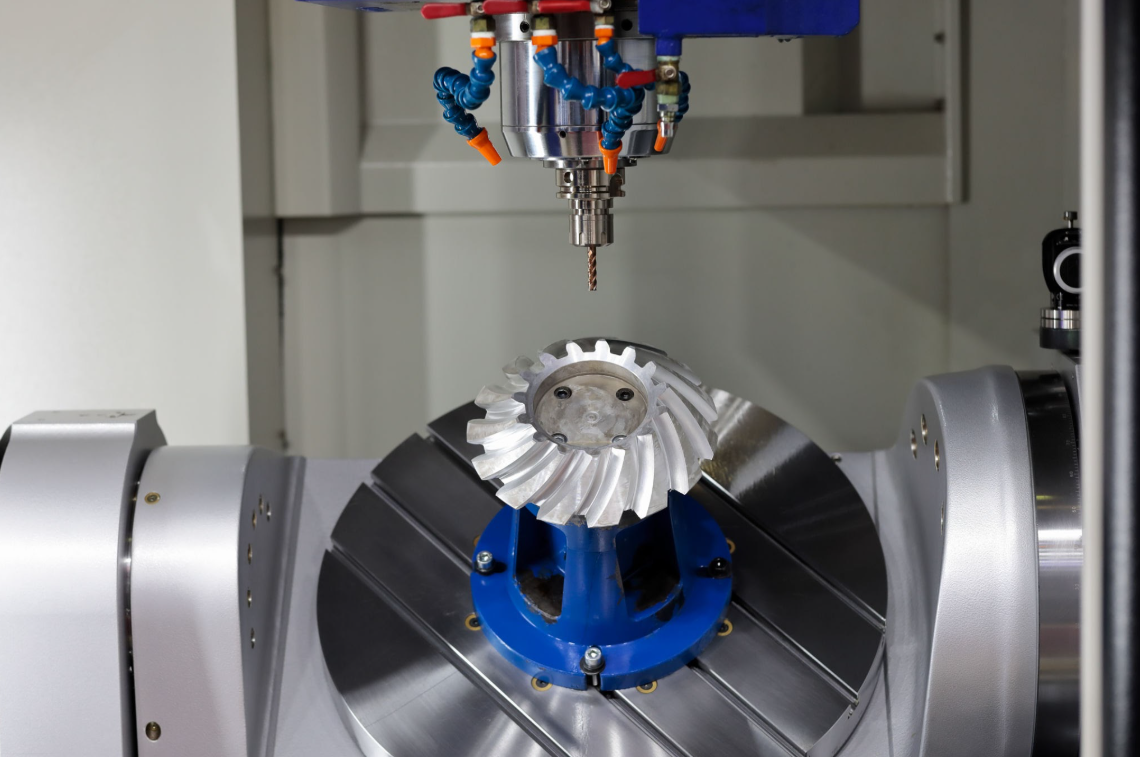
In high-performance drivetrain systems, bevel gears are critical components responsible for redirecting mechanical power. For most machine shops, however, CNC Machining of Bevel Gears represents a significant technical hurdle. Their intricate involute tooth profiles, shifting tooth thicknesses, and strict double-flank rolling tolerances leave traditional 3-axis setups completely out of their depth.
To deliver custom bevel gears capable of handling the high RPMs of modern Electric Vehicle (EV) e-axles or the near-zero backlash required in aerospace actuators, relying solely on basic CAM-generated toolpaths isn’t enough. You need a solid mix of multi-axis tactics, specialized tooling setups, and real floor-level machining instincts.
Choosing Your Setup: Traditional Gashing or Multi-Axis Milling?
Historically, manufacturing straight or spiral bevel gears required dedicated gear hobbers or shaping machines. While highly efficient for massive production runs, the lead times and costs for custom fixtures and dedicated cutters are often restrictive. Today, utilizing high-end turn-mill centers or simultaneous 5-axis CNC machining centers with standard tooling has become the go-to strategy for high-flexibility, low-to-medium volume runs.
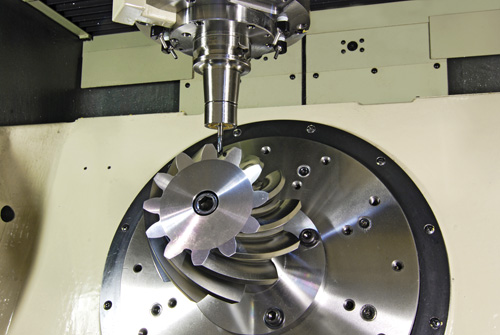
For medium to large module bevel gears, implementing a “standard machine + standard indexable tooling” process works beautifully. After generating a precise 3D model, CAM software plans out the roughing passes using adaptive pocketing or plunge milling. This leaves a uniform finishing allowance across the flanks. The beauty of this method is that it bypasses the need for proprietary cutter heads—a high-quality solid carbide ball-nose or bull-nose end mill can do the heavy lifting.
Shop-Floor Tactics: Solving Three Critical Bevel Gear Pain Points
Achieving AGMA Class 12 accuracy requires mitigating three distinct floor-level variables:
1. Eliminating Tool Chatter During Profile Finishing
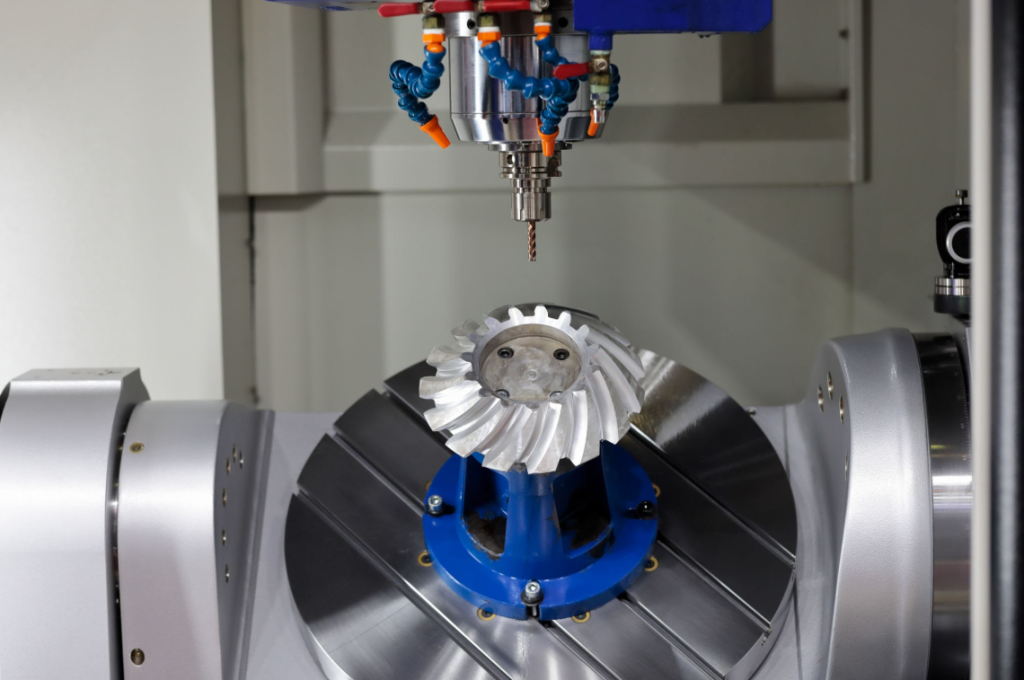
When finishing a bevel gear flank, the contact zone between the cutting edge and the tapered tooth surfaces changes constantly, which frequently triggers tool chatter. This vibration leaves micro-harmonics across the face, causing gear whine and premature failure. To combat this, adopt a “light depth of cut, high feed rate” strategy during the final pass. Using a high-helix ball end mill also directs the resultant cutting forces axially up into the spindle, suppressing radial deflection.
2. Implementing Power Skiving for Complex Geometry
If your shop utilizes rigid mill-turn machines, Power Skiving is a game-changer. By synchronizing the cutter and workpiece spindles at a precise crossed-axis angle, this continuous cutting process runs 2 to 3 times faster than traditional shaping. When machining combination components like a bevel gear with an integrated internal spline, power skiving finishes turning, face milling, and gear cutting in one clamping. This completely eliminates cumulative concentricity errors from part flip.
3. Controlling Thermal Drift and Material Distortion
Heavy roughing of gear steels like 8620H or 20CrMnTi generates massive amounts of localized friction heat. Transitioning straight to finishing passes will cause profile distortion due to workpiece thermal expansion and spindle growth. A reliable operational sequence requires separating the stages: perform your heavy roughing, send the blanks out for a stress-relief anneal, and engage active thermal compensation on the machine before finishing under a high-volume flood coolant setup.
The Hard Finishing Challenge
After carburizing and quenching, gear surfaces typically hit hard cases upwards of 60 HRC. This heat treatment inevitably introduces slight geometric distortion. To correct these final few hundredths of a millimeter, shops implement hard milling or CNC gear grinding. Utilizing PCBN (Polycrystalline Cubic Boron Nitride) inserts allows operators to skin off the distortion layer at high surface speeds, yielding a mirror-like surface finish and a perfectly centered tooth contact pattern.
Ultimately, executing successful CNC Machining of Bevel Gears comes down to maintaining rigid control over multi-axis interpolation, managing heat dissipation, and tuning parameters based on tool wear indicators. Nailing these exact floor details is what keeps high-margin, precision drivetrain contracts in your shop.