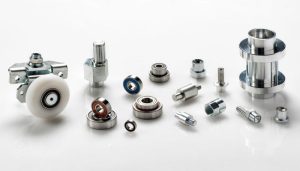
Precision CNC Machining Bronze Parts: Grade Selection, Chatter Control & Shop-Floor Tips
If you’ve ever run a heavy batch of C95400 aluminum bronze on a Friday afternoon, you know bronze isn’t just “soft yellow metal.” One wrong choice in rake angle or coolant pressure, and you’re suddenly dealing with severe work-hardening, chatter, and micro-welded bronze build-up on your carbide inserts.
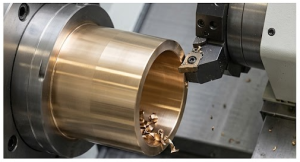
Bronze is an irreplaceable staple across marine hardware, hydraulic pumps, heavy industrial equipment, and oil field gear. It offers unmatched wear resistance, excellent anti-galling properties, and high corrosion resistance. However, converting raw bronze castings or bar stock into tight-tolerance, low-Ra finished components requires an operator who understands how distinct bronze alloys behave under the spindle.
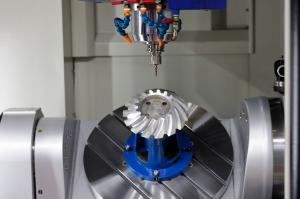
Looking for immediate production support? Check out our specialized [Custom CNC Turning Services] and [5-Axis Milling Capabilities].
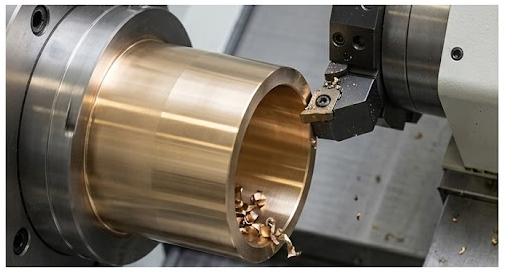
What Makes Machining Bronze Alloys Different From Other Yellow Metals?
While brass cuts cleanly with high spindle speeds and neutral rake tools, bronze is far more demanding. Unalloyed or aluminum-bearing bronzes tend to generate high friction, causing rapid heat accumulation at the tool edge.
When performing cnc machining bronze parts, machinists face three recurring challenges:
- Work Hardening: Alloys containing aluminum or nickel harden almost instantly if the tool rubs instead of shearing the material.
- BUE (Built-Up Edge): Under cutting temperatures, bronze micro-welds to tool tips, dulling the cutter and ruining surface finish.
- Part Distortion: Stresses inside continuous cast bronze bars release during roughing, turning round bores into ovals once unclamped.
Bronze Alloy Grade Comparison: Matching Material to Toolpath
Treating phosphor bronze like aluminum bronze is the fastest way to scrap an expensive workpiece. Below is a breakdown of the most common alloys running through our CNC lathes and mills:
Quick Reference Matrix for Bronze Alloys
| Bronze Alloy Grade | Equivalent Standards (UNS/DIN) | Machinability Rating | Key Characteristics | Recommended Tooling Strategy |
|---|---|---|---|---|
| SAE 660 / C93200 | CuSn7Zn4Pb7 / RG7 | 80% (High) | Lead-assisted chip breaking, anti-friction | Uncoated carbide, high SFM, standard rake |
| C95400 / C95500 | CuAl10Fe3 / Aluminum Bronze | 20% (Low/Tough) | Extreme tensile strength, high wear resistance | Sharp positive rake, DLC coating, high chip load |
| C51000 / C54400 | CuSn5 / Phosphor Bronze | 50% – 80% | High fatigue resistance, spring memory | Rigid setup, small nose radius, low overhang |
1. SAE 660 / C93200 (Bearing Bronze / CuSn7Zn4Pb7)
- Shop Floor Reality: The undisputed workhorse for sleeve bearings, thrust washers, and wear plates.
- Machinability: Excellent. The lead content acts as an internal chip breaker, allowing for higher Surface Feet per Minute (SFM) without tool clogging.
- Pro Tip: Maintain clean sump filtration; lead fines can quickly clog high-pressure coolant lines if left unmonitored.
2. C95400 / C95500 (Aluminum Bronze / CuAl10Fe3)
- Shop Floor Reality: High-load aerospace bushings, valve guides, and marine propulsion components.
- Machinability: Tough. Aluminum bronze work-hardens instantly if your tool hesitates.
- Pro Tip: Ditch light finishing passes. Use sharp carbide with small nose radii, positive rake geometry, and maintain a solid, constant feed rate to stay under the work-hardened zone.
3. C51000 / C54400 (Phosphor Bronze / CuSn5)
- Shop Floor Reality: High-frequency electrical connectors, Belleville washers, and spring contacts.
- Machinability: Moderate to high (C54400 is free-cutting).
- Pro Tip: Material has high elasticity. When boring deep cavities, anticipate spring-back—use oversized boring bars to minimize bar deflection.
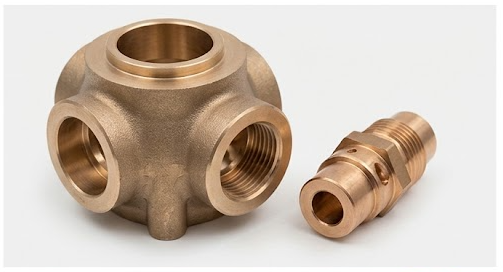
How to Machine Aluminum Bronze Without Chatter or Work Hardening
Achieving a sub-0.8 Ra finish on custom c95400 aluminum bronze parts without manual polishing requires eliminating heat spikes and chatter. Here is the protocol we run on our shop floor:
1. Breaking Up Long Ribbon Chips
Unleaded bronzes often form continuous stringy chips that wrap around the tool post, marring the part’s finish.
- Action Plan: Use polished carbide inserts designed for non-ferrous materials featuring high-wave chip breakers. Direct high-pressure coolant (70 bar / 1000 PSI) straight at the cutting point to fracture chips dynamically.
2. Eliminating Galling and Built-Up Edge (BUE)
Bronze micro-welds to carbide under high heat.
- Action Plan: Opt for uncoated polished inserts or specialized DLC (Diamond-Like Carbon) coated end mills. Avoid standard AlTiN coatings—the aluminum content in the coating can chemically bond with aluminum bronze under extreme cutting heat.
3. Preventing Deformation on Thin-Wall Sleeve Bushings
Thin-wall bronze sleeves frequently warp due to released internal stresses during turning.
- Action Plan:
- Rough turn the OD/ID, leaving 0.5mm stock allowance.
- Unclamp the part entirely and let it rest to release hoop stress.
- Finish turn using full-surface pie jaws or hydraulic expanding mandrels to equalize clamping pressure.
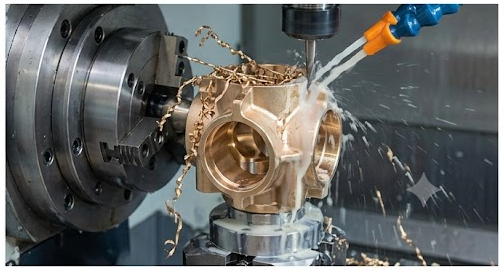
Case Study: Eliminating Chatter on a 350mm Marine Bronze Wear Ring
A marine customer brought us a C95800 nickel-aluminum bronze ring (350mm OD, 4mm wall thickness). Their former machine shop suffered a 15% scrap rate caused by heavy chatter marks and dimensional out-of-roundness.
Our Shop-Floor Overhaul:
- Workholding Upgrade: Replaced standard 3-jaw steel chucks with custom soft pie jaws, wrapping $360^\circ$ around the OD to distribute holding pressure.
- Tool Geometry: Replaced neutral inserts with $15^\circ$ positive top-rake inserts to lower radial cutting force by over 20%.
- Toolpath Optimization: Programmed dynamic trochoidal milling on internal ring grooves to maintain a constant engagement arc, eliminating thermal spikes.
The Results: Zero chatter, dimensional roundness held within 0.012mm, and cycle time cut by 18%.
Frequently Asked Questions (FAQ)
What is the recommended cutting speed (SFM) for CNC machining aluminum bronze?
For C95400 aluminum bronze using carbide tooling, start around 250–400 SFM (75–120 m/min) for roughing, and up to 600 SFM for finishing. Always maintain a positive feed rate (at least 0.12mm/rev) to prevent tool rubbing and work-hardening.
Why does bronze chatter during deep boring operations, and how do you stop it?
Bronze chatter is usually triggered by tool deflection or overly large insert nose radii generating excessive radial forces. Switch to solid carbide boring bars with heavy metal shanks, use a smaller nose radius ($0.2\text{mm} – 0.4\text{mm}$), and select positive rake geometries.
Can you cut bearing bronze dry without coolant?
While free-cutting bronzes like SAE 660 can be turned dry at low speeds, using flood coolant or high-pressure oil is strongly advised. Coolant flushes micro-chips out of deep cuts, prevents Built-Up Edge (BUE), and stabilizes part temperature to ensure tight tolerances.
Get a Quote for Your Custom Bronze Components
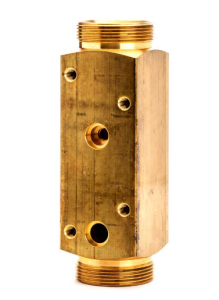
Whether you need a prototype batch of SAE 660 bearings or full-production 5 axis cnc milling phosphor bronze valve housings, executing bronze parts requires material-specific machining strategy.
Send your 3D STEP files and prints to our engineering team today for an instant DFM review and competitive quote.