In aerospace manufacturing, zero-defect production is non-negotiable. When executing cnc machining aircraft parts, machine shops face a unforgiving combination of ultra-tight geometric tolerances—often down to $\pm 0.005\text{ mm}$ ($\pm 0.0002″$)—and complex thin-wall geometries designed to minimize airframe weight.
Whether you are cutting structural ribs from solid aluminum 7075-T6 billets or hogging out high-temperature engine mounts from Ti-6Al-4V, transferring a CAD model into a flight-certified component requires deep process control.
Here is a practical, engineering-first guide on how our machine shop addresses residual stress relief, tool deflection, and AS9100D compliance during the cnc machining aircraft parts workflow.
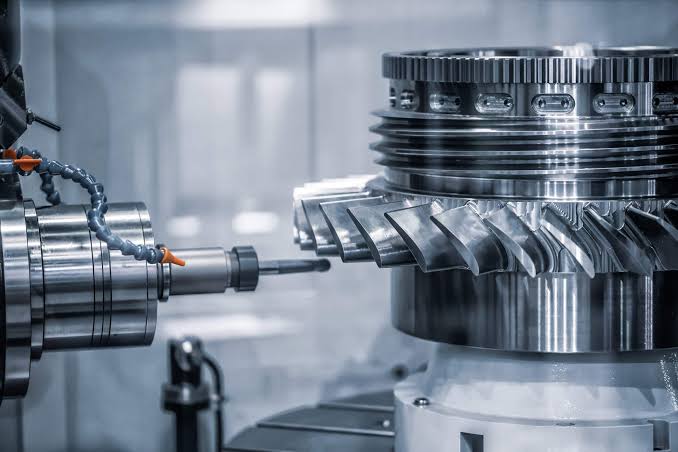
1. Tackling Thin-Wall Distortion & Residual Stress in Aircraft Structures
Thin-wall structures are ubiquitous in modern airframes to achieve maximum strength-to-weight ratios. However, milling internal pockets often releases internal stresses stored in forged or rolled stock, causing the part to warp once released from the fixture.
Machining Strategy: Traditional Hogging vs. High-Efficiency Milling (HEM)
To maintain wall thickness down to 1.0 mm without chatter or taper, we utilize dynamic trochoidal toolpaths combined with strategic stock removal steps:
| Processing Parameter | Standard Pocketing | High-Efficiency Milling (HEM / Dynamic) | Shop-Floor Impact |
| Radial Cut Depth ($a_e$) | $50\% – 100\%$ Tool Diameter | $5\% – 15\%$ Tool Diameter | Dramatically reduces lateral bending forces on thin walls. |
| Axial Cut Depth ($a_p$) | $1.0\text{x} – 1.5\text{x}$ Tool Diameter | $2.0\text{x} – 3.0\text{x}$ Tool Diameter | Spreads cutter wear evenly across the entire flute length. |
| Heat Dissipation | Concentrated at tool tip | Evacuated rapidly through chips | Prevents thermal expansion of delicate structural ribs. |
Practical Anti-Distortion Rules
- Symmetrical Roughing: Always rough-machine both sides of an airframe component sequentially to relieve stress evenly before executing any semi-finishing passes.
- Balanced Finishing Allowance: Leave a uniform $0.2\text{ mm} – 0.3\text{ mm}$ stock on thin webs for the final pass. Cutting with variable stock causes inconsistent tool deflection and out-of-tolerance tapering.
- Vacuum & Custom Soft Jaws: When standard hydraulic vises distort delicate skins, use custom vacuum plates or low-melting-point alloy potting to support complex geometries.
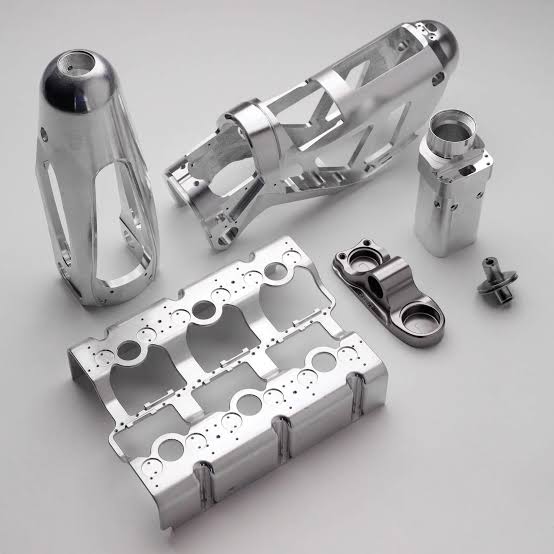
2. Material-Specific Guidelines: Machining Aerospace Superalloys
Selecting the right parameters for cnc machining aircraft parts depends heavily on material behavior under high shear loads.
Aluminum 7075-T6 & 2024-T3
- Primary Use: Fuselage frames, wing spars, skin panels.
- Machining Focus: High Material Removal Rate (MRR). We run balance-tested G2.5 tool holders at speeds up to 20,000 RPM with high-pressure coolant (70 Bar / 1000 PSI) to flush chips immediately and eliminate recutting.
- [内部链接建议锚文本: Learn more about our [Precision Aluminum Machining Services]]
Titanium Ti-6Al-4V (Grade 5)
- Primary Use: Landing gear fittings, engine mounts, fastener hardware.
- Machining Focus: Low thermal conductivity means heat stays at the cutting edge. We utilize solid carbide end mills with AlTiN coatings, maintaining a high feed per tooth to stay ahead of the work-hardening zone.
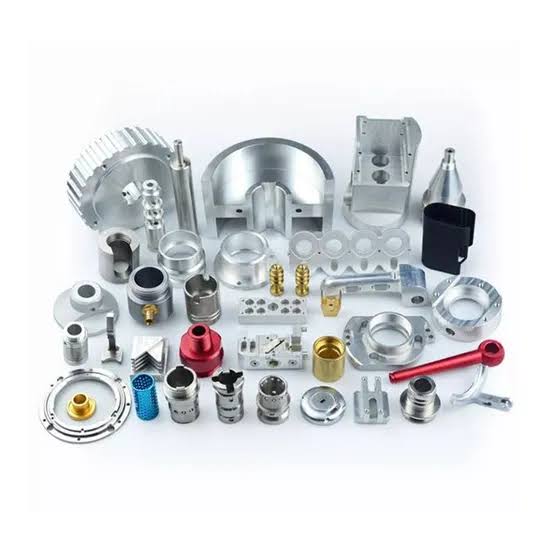
3. Quality Assurance & AS9100D Traceability
Producing flight-critical hardware requires strict adherence to international quality frameworks. In our shop, process verification occurs at every stage:
- On-Machine Inspection (OMI): Using Renishaw touch probes, we measure critical datums and auto-adjust Work Coordinate Systems (WCS) mid-process to correct for thermal drift in the CNC machine.
- Coordinate Measuring Machine (CMM): Final dimensions are validated in a climate-controlled inspection lab ($\pm 0.001\text{ mm}$ CMM accuracy).
- First Article Inspection Report (FAIR): Every batch of cnc machining aircraft parts is delivered with full [SAE AS9102 FAIR documentation], raw material test reports (MTRs), and heat-treat certs.
Frequently Asked Questions (FAQ)
Q1: What tolerances can be achieved when executing CNC machining aircraft parts?
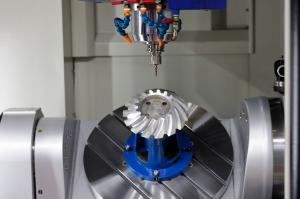
A: Standard aerospace machining holds tolerances of $\pm 0.025\text{ mm}$ ($\pm 0.001″$). For critical flight features such as bearing bores and interface pins, our precision 5-axis machines achieve tight tolerances down to $\pm 0.005\text{ mm}$ ($\pm 0.0002″$).
Q2: How do you prevent chatter when milling deep-pocket aircraft components?
A: We combine variable-pitch end mills to break up harmonic vibration, use shrink-fit tool holders for maximum rigidity, and apply High-Efficiency Milling (HEM) toolpaths with low radial immersion ($a_e \le 10\%$).
Q3: What quality certifications are required for aerospace CNC machine shops?
A: Top-tier aerospace suppliers must hold AS9100D (Quality Management Systems for Aviation, Space, and Defense) and ISO 9001:2015 certifications, alongside Nadcap accreditations for special processes like anodizing or non-destructive testing (NDT).
Ready to Elevate Your Aerospace Component Quality?
If you are currently facing high scrap rates, wall deformation, or tight tolerance bottlenecks on your cnc machining aircraft parts, our engineering team is ready to assist.
Send us your 3D CAD models (STEP/IGES) today for a complete DFM (Design for Manufacturability) evaluation, material sourcing breakdown, and formal quotation.