Introduction
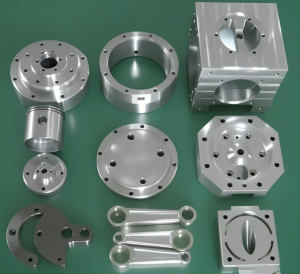
In high‑power electronics, automotive systems, 5G infrastructure, and high‑performance computing, effective thermal management is non‑negotiable. CNC machining of heat sinks delivers unmatched precision, design flexibility, and fast turnaround for complex, low‑to‑mid volume thermal components that extrusion, die casting, and cold forging cannot achieve. Ideal for prototyping, small‑batch production, and highly specialized heat sinks, CNC machining — supported by EDM, 5‑axis capabilities, and advanced automation — ensures optimal heat dissipation, tight tolerances, and reliable performance in mission‑critical applications. HLW provides end‑to‑end CNC machined heat sink solutions with professional DFM analysis, material expertise, and global delivery for international buyers.
Why CNC Machining Stands Out for Heat Sink Manufacturing
Traditional mass production methods (extrusion, die casting, cold forging) require expensive tooling, limit geometric complexity, and lack agility for prototyping. CNC machining solves these pain points with unique advantages:
- High precision & tight tolerances: Maintains exact dimensions down to ±0.003 mm for perfect component interfacing.
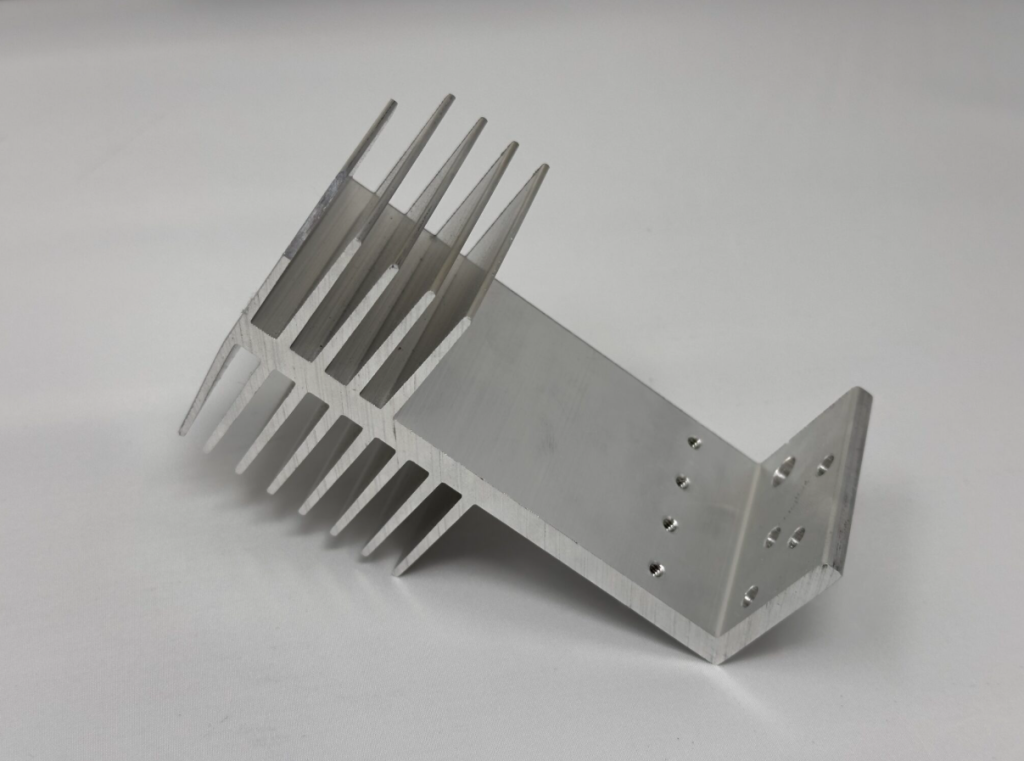
- Complex geometry freedom: Creates intricate fins, undercuts, thin walls, stepped bases, and angled structures not feasible with extrusion.
- Rapid prototyping & iteration: No custom tooling means short lead times and quick design adjustments.
- Broad material compatibility: Processes aluminum, copper, and high‑performance alloys.
- Automation readiness: Integrates with robotics and pallet systems for unattended, consistent production.
- Superior surface finishes: Smooth surfaces minimize thermal resistance and boost heat transfer efficiency.
CNC machining is also the only viable method for highly specialized heat sinks combining complex shapes and strict tolerances.
Key CNC Machining Technologies for Heat Sinks
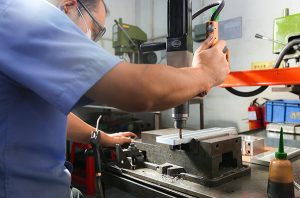
1. Conventional CNC Machining
The foundation of precision heat sink production, ideal for fin forming, mounting features, and surface finishing. It supports automated production and delivers consistent quality for small‑to‑mid batches.
2. Electrical Discharge Machining (EDM)
A non‑contact process that erodes material using electrical discharges, perfect for hard metals and internal geometries:
- Wire EDM: Cuts narrow slots, thin fins, and precise contours in copper and aluminum alloys.
- Sinker EDM: Creates deep cavities, complex internal structures, and fine features inaccessible with standard tools.
- Shared benefits: No tooling, high accuracy, short lead times for prototypes and complex parts.
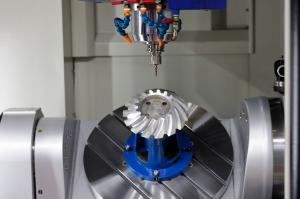
3. 5‑Axis CNC Machining
Goes beyond 3‑axis machining with simultaneous 5‑axis movement:
- Processes fully complex geometries in one setup, reducing operations and errors.
- Delivers premium surface finishes critical for thermal performance.
- Improves time efficiency for high‑complexity projects.
4. Horizontal Milling Machines
Essential for fin slotting, deburring, and deep‑cut stability:
- Stable material removal for consistent fin structures.
- Supports long tools for deep slots and large workpieces.
- Produces burr‑free edges for safe handling and optimal heat dissipation.
Manufacturing Automation for Heat Sinks
HLW optimizes heat sink production with Fanuc robots and the Trinity AX5 pallet system, enabling:
- Unattended overnight and weekend production.
- Higher output, reduced human error, and better floor space usage.
- Consistent quality and lower per‑unit costs for medium runs.
Critical DFM Guidelines for CNC Machined Heat Sinks
Designing for manufacturability reduces cost, lead time, and scrap while preserving thermal performance. Follow these non‑negotiable parameters:
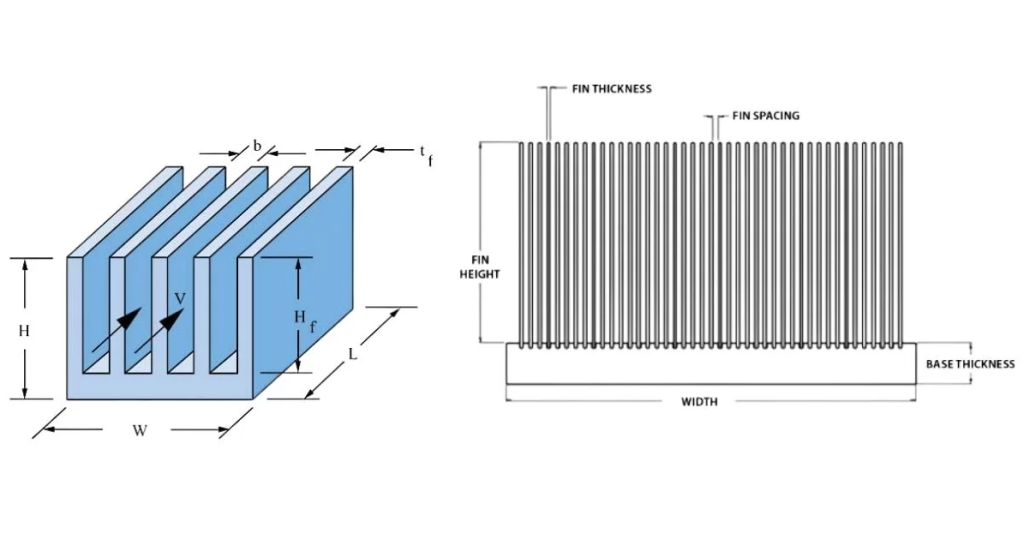
Fin Design Parameters (Aluminum vs. Copper)
| Parameter | Aluminum Minimum | Copper Minimum |
|---|---|---|
| Fin Thickness | ≥ 0.8 mm | ≥ 1.0 mm |
| Fin Spacing | ≥ 1.5 mm | ≥ 1.8 mm |
| Max Aspect Ratio (H/D) | ≤ 6:1 | ≤ 4:1 |
Tolerance Standards for Thermal Efficiency
- Contact surface flatness: ≤ ±0.05 mm
- Hole positional accuracy: ≤ ±0.02 mm
- Thread depth consistency: ≤ ±0.1 mm
Core DFM Best Practices
- Use fillets at internal corners to avoid EDM or special tooling.
- Limit pocket depth to 4× tool diameter to prevent tool breakage.
- Consolidate features to reduce secondary operations.
- Avoid ultra‑deep fins that cause vibration and tool deflection.
Material Selection: Aluminum vs. Copper for Heat Sinks
Material choice balances thermal conductivity, weight, machinability, and cost.
Aluminum (6061‑T6 / 6063‑T5)
- Thermal conductivity: ~200–230 W/m·K
- Density: ~2.7 g/cm³ (lightweight)
- Excellent machinability, low tool wear
- Lower cost, widely used for most applications
Copper (C11000 / 99.9% pure)
- Thermal conductivity: ~390–400 W/m·K (superior)
- Density: ~8.9 g/cm³ (3× heavier than aluminum)
- Difficult machining: burring, tool adhesion, slower feeds
- Best for high‑heat‑flux base plates
Hybrid Designs
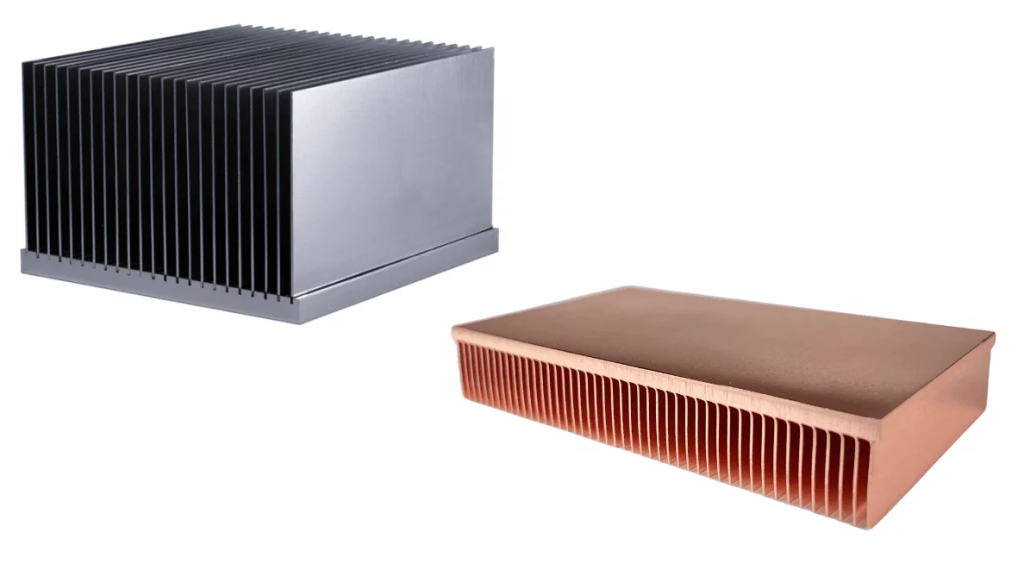
Combine a copper base (direct heat contact) with aluminum fins (convection cooling) for optimized performance and cost. CNC machining enables precise assembly via press‑fit, thermal adhesive, or brazing.
Surface Finishes & Treatments for Thermal & Environmental Performance
Post‑machining finishing enhances heat dissipation, corrosion resistance, and durability:
- Anodizing (aluminum): Improves emissivity, corrosion resistance, and dielectric isolation; black anodizing is preferred for telecom and lighting.
- Nickel plating (copper): Prevents oxidation and maintains thermal contact efficiency.
- Brushed / sandblasted finishes: Boosts airflow turbulence and aesthetics without changing dimensions.
CNC Machining vs. Extrusion: Which to Choose?
| Application | CNC Machining | Extrusion |
|---|---|---|
| Complex geometries, multi‑directional fins | ✅ Ideal | ❌ Limited |
| Prototyping & fast iteration | ✅ Best | ❌ Slow (tooling lead time) |
| Low‑to‑mid volume (<5,000 units) | ✅ Cost‑effective | ❌ High tooling cost |
| High‑volume simple uniform profiles | ❌ Higher per‑piece cost | ✅ Most efficient |
Choose CNC machining when precision, customization, and speed matter more than mass‑production cost efficiency.
Applications of CNC Machined Heat Sinks
CNC machined heat sinks serve high‑performance industries worldwide:
- 5G base stations, telecom RF modules, and high‑watt amplifiers
- Automotive ECUs, EV inverters, and battery management systems
- High‑performance computing, CPUs, and server cooling
- LED lighting, medical devices, and industrial sensors
Why Choose HLW for Your CNC Machined Heat Sinks
HLW is a trusted global supplier of precision CNC machined heat sinks with:
- ISO 9001, IATF 16949 certified manufacturing
- In‑house 3‑axis, 5‑axis, EDM, and horizontal milling capabilities
- Full DFM analysis and thermal design support
- Fast quoting, 1‑day rapid prototyping, and 3–5 day standard lead times
- Transparent pricing, real‑time order tracking, and global logistics
- Dedicated engineering support for custom thermal solutions
Call to Action
Get a precise, cost‑effective CNC machined heat sink tailored to your thermal requirements. Contact HLW today for a free quote and DFM analysis.
- Phone: +86 18664342076
- Email: info@helanwangsf.com
- Upload your CAD files for instant feedback and competitive pricing.